Most design relationships are transactional by design: you hire someone, they deliver the files, and the relationship ends. The next time you need something, you start over—re-explaining your brand, your audience, your approvals process, your history. Every new project costs more time than it should, and the work never quite builds on itself.
My client relationships don’t work that way. Here’s why.
For over 20 years, I’ve been using some version of The Stewardship Flywheel with every client. I just didn’t know it had a name.
The process was always there: asking the right questions, scoping projects to fit real budgets, designing materials a small team could actually maintain, and showing up again and again as organizations grew and changed. At some point I realized that my longest client relationships—some going on a decade or more—all had something in common. Nobody was starting from scratch. I knew where the logo files lived. I knew which board member preferred a more conservative look. I knew that their annual report needed to be done by October because that’s when their gala was. And because of that, the work got better every year, not just different.
In practice, that looks like this:
- A client calls and says “I need graphics for this event” and we’re off and running in minutes, not hours, because I already know their brand, their files, and how they like to work.
- When their communications coordinator leaves and a new one starts, nothing falls apart, because the systems, templates, and guidelines are already in place.
- When a project comes in that their small team will eventually need to update themselves, I build it that way from the start—whether that means social graphics in Canva or a whitepaper template in Word.
That’s not luck. That’s a system. It just took me a while to see it as one.
The organizations I work with—nonprofits, educational institutions, and mission-driven companies—are doing important work with limited resources. They rarely have in-house design departments, and their small teams are already stretched across programs, fundraising, and operations. They know that clear, credible communications matter for building donor trust, recruiting supporters, and making their mission legible to the world. But without organized systems and someone who actually knows their brand, it’s remarkably hard to stay consistent—especially when staff turns over, budgets shift, or a new program launches and everything needs to be updated at once.
What was missing wasn’t talent or intention. It was continuity.
The Stewardship Flywheel is my answer to that. It’s the five-part process I’ve followed instinctively for two decades, made explicit so my clients can see exactly how we work together, and why it works better over time. From the first honest conversation about what’s actually needed, through the design and systems work, to showing up as a dedicated extension of their team for whatever comes next. The loop doesn’t end when the project does. It just keeps turning—a little faster, with a little more knowledge on both sides, every time.
I’ve watched clients go from scrambling for their own logo files to running smooth, consistent communications across multiple programs and platforms—not because they hired a full-time designer, but because we built something sustainable together. That’s what long-term brand care actually looks like. And that’s what The Stewardship Flywheel is built to deliver.
Here’s how it works in practice, when I’m working with the Weiher Creative team through the process.
The Stewardship Flywheel
Good design starts with good communication. And good communication doesn’t happen by accident.
For most mission-driven organizations, the real challenge isn’t finding someone who can make things look professional. It’s finding a partner who understands your constraints, stays consistent as your team and priorities shift, and builds communications that hold up over time—not just for one campaign or one annual report, but across the life of your organization.
That’s what The Stewardship Flywheel is designed to do.
Developed over 20 years of working with nonprofits, educational institutions, and mission-driven organizations, the Stewardship Flywheel is the framework that guides every client relationship at Weiher Creative. It’s not a one-time process—it’s a continuous cycle that we return to at the start of every new project and every new phase of work. The longer we work together, the less you have to explain, the easier your job gets, and the better and more consistent your communications become.
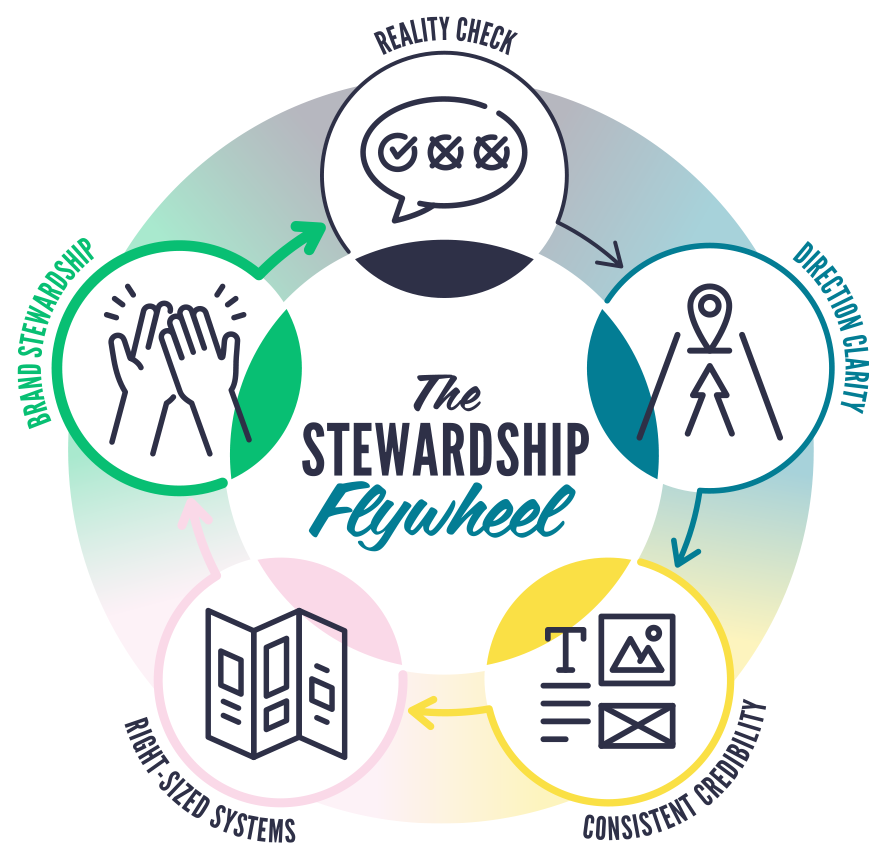
How the Flywheel Works
Each engagement moves through five phases—and then the flywheel turns again, carrying everything we’ve learned forward with it. That’s not inefficiency, it’s intentional. Returning to Reality Check at the start of every project ensures we’re always working from current information, not assumptions from six months ago.
1. Reality Check
Before anything else, we get honest about what’s actually needed—and what’s realistic given your capacity, timeline, and budget. This is the conversation most design partners skip, and it’s the one that prevents the most problems down the road.
In this phase, we might:
- Review your current communications and identify what’s working and what isn’t
- Clarify the scope of the project and confirm it’s the right priority right now
- Discuss timeline, budget, and approval processes so there are no surprises later
- Ask: Who’s doing your design right now, and how is that going? What would success look like for this project? Who needs to update this moving forward, and how can we make it easy for them?
2. Direction Clarity
Once we know what we’re working with, we make sure we’re solving the right problem before we start building anything. Good design that communicates the wrong thing is still a miss, so we slow down here to go faster later.
In this phase, we might:
- Define the audience and what they need to understand or feel
- Clarify the goal of the piece—what action should it drive, what message should it leave?
- Identify what’s most important to communicate
- Ask: Who is this for? What do we need them to do or believe after seeing this?
3. Consistent Credibility
This is where the design work happens. We create communications that look and feel like your organization, every time. Consistent brand elements, consistent tone, consistent quality. Because credibility isn’t built in a single piece—it compounds across every touchpoint your audience encounters. Good design, applied consistently, builds trust with your audience.
In this phase, we:
- Design print and digital materials including annual reports, donor communications, brochures, event materials, and websites
- Apply and reinforce your brand standards across every element—typography, color, imagery, and tone
- Ensure that everyone on your team is working from the same brand assets and guidelines
- Present design concepts, incorporate feedback, and refine through revision rounds
- Ensure that materials are accessible and align with current standards
4. Right-Sized Systems
Great design only works if your team can maintain it. We don’t build systems that require a full-time designer to operate—we build tools sized for the staff and capacity you actually have, so your communications stay consistent even when we’re not actively working together.
In this phase, we might:
- Create branded templates for recurring materials like newsletters, social graphics, and presentations
- Organize and deliver final files in formats your team can actually use
- Document brand guidelines in a simple, accessible reference your whole team can follow
- Train staff on basic updates so small changes don’t require a new project every time
5. Brand Stewardship
We stick around. As a dedicated extension of your team, we evolve with you through staff transitions, program changes, and shifting priorities. We’re here when you need us, and your brand stays coherent because someone who knows it deeply is always in your corner, ready to pick up where we left off without missing a beat.
In this phase, we might:
- Serve as your on-call design resource for new projects and urgent needs
- Revisit brand standards as your organization grows or evolves
- Provide continuity through staff turnover—so institutional knowledge doesn’t walk out the door
- Keep the flywheel turning: as new projects arise, we’ll reflect on what went well last time and what needs improvement, so that every time we start a new engagement, our processes run more smoothly and our communication is clearer.
The result: Communications that are clear, credible, and built to last—because they’re grounded in a real understanding of your organization, your audience, and what you can actually sustain.
Ready to talk about where you are and how we can help?
The Stewardship Flywheel was created by Amy Weiher, founder of Weiher Creative, to help mission-driven organizations communicate clearly and credibly, maintain brand continuity, and do more with the time, tools, and staff they already have.